
Chapter Content
School and University Years
2.1 The Academic Gymnasium at SPbSU
Following his return to Saint Petersburg from Italy in 1995, Pavel Durov was admitted to the prestigious Academic Gymnasium (now the Academic Lyceum) affiliated with Saint Petersburg State University. The gymnasium was an elite educational institution designed for students demonstrating advanced aptitude in mathematics, natural sciences, and linguistics.
The curriculum at the Academic Gymnasium was exceptionally rigorous, offering intensive multi-language instruction alongside advanced mathematical training. Pavel excelled across both linguistic and technical disciplines, graduating with a silver medal in 2002.
   [Classical Gymnasium Curriculum] ----> Multilingual Fluency (English, Italian, Latin)
   [Early Computing Exploration]   ----> Self-Directed Study of Pascal, C & Web Scripting
   [SPbSU Philological Faculty]    ----> Translation, Semiotics, Rhetoric & Mass Media
2.2 Early Programming & School Computer Lab Incidents
During his gymnasium years, Pavel developed a passion for software development, experimenting with languages like Pascal and early web development tools on IBM-compatible PCs running MS-DOS and Windows in the school's computer lab.
Biographies and media accounts (such as Nikolai Kononov's *The Durov Code*) recount anecdotes of Pavel finding ways around administrative access controls on the school's computer lab network to customize desktop settings or change terminal wallpapers to display provocative messages to teachers and peers.
While popular accounts sometimes dramatize these incidents by attributing specific exploit payloads or buffer overflow mechanisms to the teenage student, the exact technical mechanisms are not publicly documented in primary technical archives. What is historically verified is that Pavel demonstrated an early interest in software architecture, permissions boundaries, and questioning administrative restrictions.
2.3 Educational Concept: Memory Allocation and Boundary Validation
To understand how legacy software environments handled memory safety and how buffer boundary vulnerabilities arise in low-level languages, examine this general educational C++ module illustrating the difference between unvalidated memory operations and bounds-checked memory handling:
// =========================================================================
// EDUCATIONAL EXAMPLE: Memory Boundary Validation in C++
// NOTE: This is a general educational illustration of memory management concepts,
// NOT a technical reconstruction of Durov's school computer lab incident.
// =========================================================================
#include <iostream>
#include <cstring>
#include <string>

// Educational demonstration of fixed-size buffer handling
void SafeBufferCopy(const std::string& input_data) {
    constexpr size_t BUFFER_CAPACITY = 32;
    char safe_buffer[BUFFER_CAPACITY] = {0};

    std::cout << "[INFO] Validating input payload length..." << std::endl;

    // Secure programming practice: verify length before copying into fixed array
    if (input_data.length() < BUFFER_CAPACITY) {
        std::memcpy(safe_buffer, input_data.c_str(), input_data.length());
        safe_buffer[input_data.length()] = '\0';
        std::cout << "[SUCCESS] Input stored safely in buffer: " << safe_buffer << std::endl;
    } else {
        std::cerr << "[SECURITY ALERT] Input exceeds buffer capacity! Operation rejected." << std::endl;
    }
}

int main() {
    std::string test_payload = "Authorized_User_Session_Token";
    SafeBufferCopy(test_payload);
    return 0;
}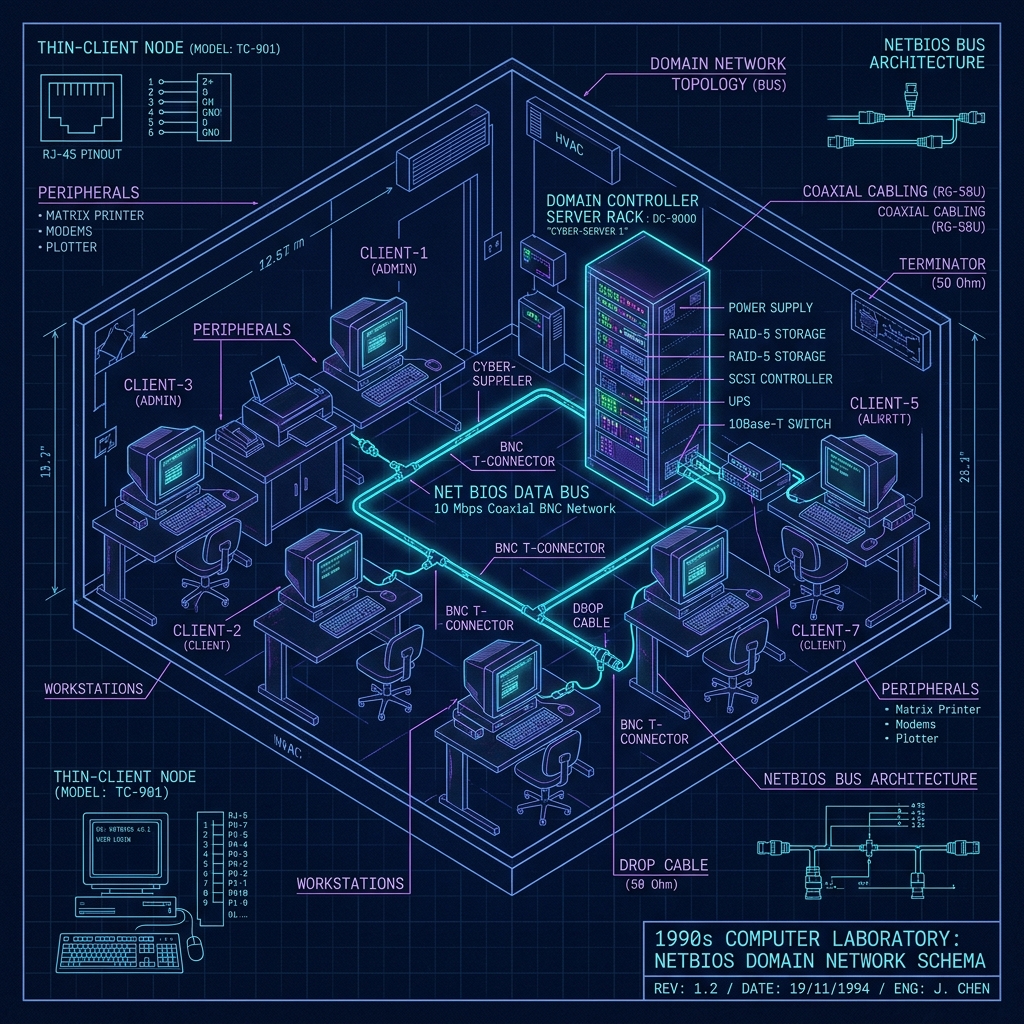
Historical visual illustration representing the 1990s computer laboratory environment at the Academic Gymnasium where early personal computers were introduced.
2.4 University Studies: Philology and Digital Media
In 2002, Pavel enrolled in the Philological Faculty of Saint Petersburg State University, majoring in English Philology and Translation. While many classmates expected him to pursue pure mathematics or computer science like his brother Nikolai, Pavel chose to study linguistics, semiotics, and rhetoric.
Durov recognized that while code execution was a technical tool, understanding human communication, psychology, and information dissemination was essential for building digital platforms. During his university years, Pavel combined his philological coursework with independent web engineering, mastering PHP, MySQL, HTML, and CSS. He was a high-performing student, earning prestigious academic honors including the Potanin Scholarship and the Scholarship of the Government of the Russian Federation.